Last updated 24 October 2026 — by Adrian Tan, SDM. Marketing guidance, not legal advice. References are to Singapore legislation as shown on Singapore Statutes Online on 24 October 2026, and to LTA and IMDA pages and documents published up to that date. Where we interpret how a rule applies, we say so.
A bubble-tea chain books a full bus wrap for its launch month. A tuition centre wants A5 posters near the MRT exit closest to its branch. A renovation firm asks its drivers to put the company logo and a QR code on every lorry. A property agent wonders whether a Grab driver could carry a seat-back flyer for a new launch. A gym hires students to hand out trial passes on the station concourse.
All five are transit or vehicle advertising, and all five run into different rules. Singapore has no single “transit advertising law”. Instead, four layers apply at the same time: permission for the space (from LTA, the Registrar of Vehicles or a landowner), physical safety rules for wraps, lights and screens, content rules (the advertising code and the Undesirable Publications Act), and, for networked screens, an IMDA broadcast licence. Miss one layer and the campaign can come down, even if the others are in order.
This guide is for marketers, business owners and media planners booking out-of-home campaigns on Singapore’s transport network or turning their own vehicles into moving billboards. It covers each surface, the 2025 changes, penalties, worked examples and a checklist.
The short version
- MRT trains need LTA’s written permission. Displaying any advertisement in or on a train without it is an offence with a fine of up to $5,000.
- Flyering in MRT stations needs permission too. Handing out promotional material or samples on railway premises without written permission from LTA or the operator is an offence.
- Any public service vehicle needs the Registrar’s approval for ads. That covers buses, taxis and, in our reading, private-hire cars.
- Private bus wraps got easier in August 2025. LTA no longer requires approval for wraps that follow its guidelines, but 2D and 3D fixtures still need approval.
- Public bus advertising is sold by one operator. Moove Media has managed ad spaces on all public buses and bus interchanges since 1 November 2025.
Who controls which surface
The first question for any transit campaign is whose permission covers the surface.
MRT trains and stations
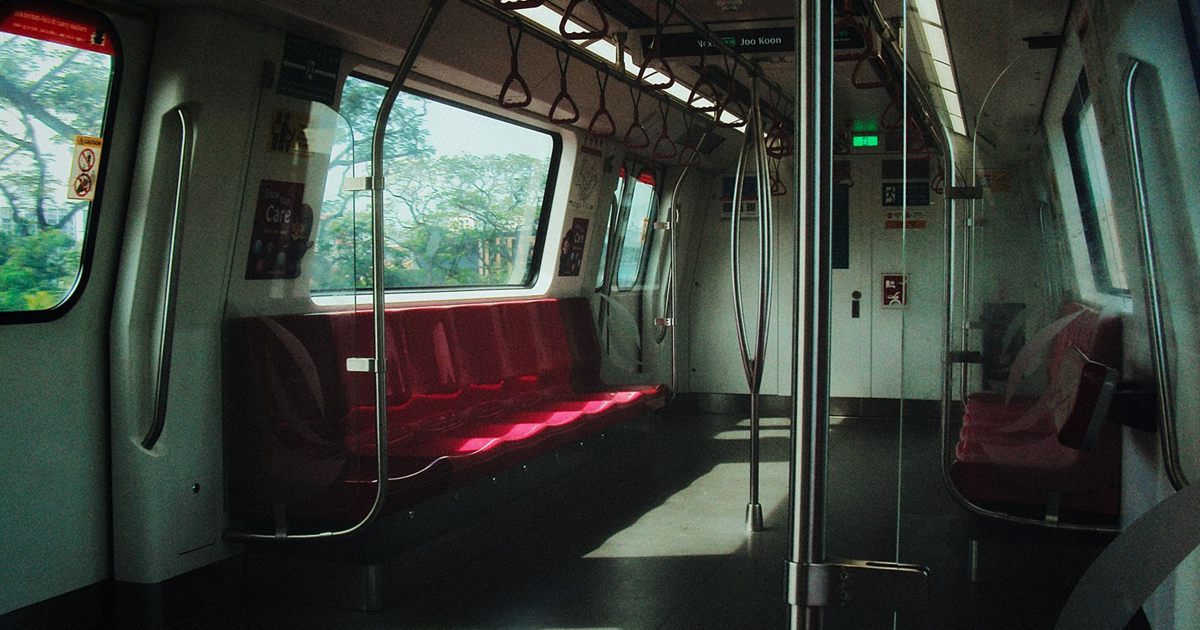
Ads on and in trains
The Rapid Transit Systems (Advertisements on Trains) Regulations are short and blunt. Regulation 3(1) says no person may display any advertisement in or on any train without LTA’s written permission, and must follow the conditions attached to it. “Advertisement” is defined widely in regulation 2: any notice, sign, label, circular, announcement or intimation visible to the public. A sticker on a window, a hanging strap printed with a logo and a full train wrap are all advertisements.
Regulation 4 sets the penalty at a fine of up to $5,000, plus up to $100 a day for a continuing offence, and regulation 5 makes the offence compoundable. In practice, an advertiser books train media through the operator’s media sales arm, which holds the permission and carries the conditions. What matters for the advertiser is that the booking comes from someone who actually holds the right to sell that space. A “guerrilla” sticker campaign inside carriages has no such cover.
Flyering, sampling and roadshows in stations
The Rapid Transit Systems Regulations deal with what happens on railway premises. Regulation 21(c) bars anyone, without the written permission of LTA or its licensee, from displaying, exhibiting or distributing printed or pictorial matter or samples for advertising or publicity. Regulation 21(a) and (b) also bar touting and selling. The Schedule sets a maximum fine of $1,000, and the offence is compoundable.
That covers the gym promoters handing out trial passes on the concourse, the sampling team giving away drinks at the faregates and the student with a stack of tuition flyers at the exit. Each needs written permission for that station. Outside the station boundary the question becomes whose land it is, and putting up posters on public property without written authority is vandalism, which our guide to outdoor signage and billboard rules in Singapore covers in detail.
Who sells station and train media
LTA does not sell ad space on the rail network itself; operators and their appointed media owners do. A ComfortDelGro release of 19 May 2025 said its partnership with Moove Media would also cover advertising at 52 stations on the Downtown and North East Lines, the Sengkang and Punggol LRT and ComfortDelGro taxis. For other lines, ask the operator which media owner holds the concession. We found no operator that publishes its content rules, lead times or rate cards, so get these in writing at booking.
Public buses and interchanges after November 2025
On 19 May 2025, LTA announced Moove Media as the advertising operator for all public buses and all bus interchanges from 1 November 2025. The contract runs for seven years with an option for two more and covers about 5,800 buses and 28 interchanges, with concession fees of about $150 million. LTA said the operator plans formats including dynamic displays and 3D buses.
For advertisers, this means one counterparty for the whole public bus fleet. It also brought back full-body bus wraps. Under the bus contracting model from 2016, public bus ads had been limited to the rear two-thirds of the bus. Land Transport Guru, an enthusiast site that tracks the fleet, reported in October 2025 that full-body ads were returning under the new contract, with the front of the bus kept clear and operator logos in fixed positions. We cite that as reporting, not as a published rule; the exact panel layout comes from the media owner.
Because a public bus is a public service vehicle, the Registrar’s approval under PSV Rules regulation 66 still sits behind every ad. In practice the media owner handles that, which is one more reason to book through the concession holder rather than approach a bus operator or depot directly.
Private, company and school buses
Many businesses own or charter buses: shuttle services, tour companies, schools, factories with staff transport. LTA’s page on advertising on buses, last updated 13 August 2025, made one change that matters: from 18 August 2025, bus owners no longer need LTA approval for bus wraps, but must still follow LTA’s guidelines. 2D or 3D fixtures, meaning anything that sticks out from the body, still need LTA approval, with drawings and calculations from a registered Professional Engineer.
The physical rules come from LTA’s page and its Terms and Conditions for Advertisement In/On Private Buses (updated 27 September 2023), which cover excursion, private hire, private and school buses.
Put together, the rules for private buses are:
- Front: no advertising on the front of the bus, and no stickers on the front windscreen.
- Side windows: perforated window stickers must stay at least 40% see-through and may cover no more than 25% of the side glass.
- Rear glass: may be fully covered if the number plate and speed-limit sign remain visible.
- Emergency exits: must not be obscured.
- Height: total height including any fixture must not exceed 4 metres.
- Lights: lighted advertisements are not allowed.
- Content: ads must be decent and in good taste, and the advertiser must ensure they are truthful and comply with the Undesirable Publications Act 1967 and the Singapore Code of Advertising Practice (SCAP).
- School buses: need the school’s clearance before LTA’s approval, and must not promote negative values.
- Agents: an appointed advertising agent shares responsibility with the bus owner.
- Removal: LTA may order an ad removed without liability, and repeat offenders risk fines, court charges or suspension or revocation of their bus licence.
One wrinkle: the 2023 terms still describe an approval step, and PSV Rules regulation 66 still reads as a requirement for the Registrar’s prior written approval. LTA’s 2025 web page is the later statement and says wraps no longer need approval. In our reading, LTA has in effect approved compliant wraps on a standing basis, so a wrap that follows the guidelines is fine and anything outside them, such as a fixture or a lit panel, falls back to needing approval. If your design is borderline, ask LTA.
Taxis and private-hire cars
Regulation 66 of the Road Traffic (Public Service Vehicles) Rules is one sentence: no advertisement shall be displayed inside or outside a public service vehicle without the prior written approval of the Registrar. The Road Traffic Act defines a public service vehicle as a vehicle used or kept for use to carry passengers for hire or reward, including a car hired as a whole under a contract. Taxis are clearly in. In our reading, so are private-hire cars, because they are cars hired under a contract to carry passengers.
The PSV Rules set no specific penalty for regulation 66, so the general penalty in section 131(2) of the Road Traffic Act applies: a fine of up to $1,000 or up to three months’ imprisonment for a first offence, and up to $2,000 or six months for a repeat offence.
The practical consequence is that a ride-hail driver cannot simply accept a fee to put a sticker on the door or a stack of flyers in the seat pocket. Taxi advertising is sold by the taxi companies’ media partners, who handle approval; ComfortDelGro’s taxis are in the Moove Media partnership described above. We found no published LTA process for advertising on individual private-hire cars, so a brand that wants to run a campaign through ride-hail drivers should get the Registrar’s written approval first, or work through a platform or media owner that has it.
The car-sales side is separate: rules on how dealers advertise cars for sale, such as COE and rebate claims, are in our guide to car advertising rules in Singapore.
Your own company cars, vans and lorries
A business’s own vehicle that is not used to carry passengers for hire is not a public service vehicle, so regulation 66 does not apply and no advertising permit is needed to put your logo, phone number or QR code on it. Three sets of safety rules still bite.
- No taxi look-alikes. Regulation 126A of the Construction and Use Rules, in force since 1 February 2018, bars a vehicle that is not a taxi from displaying the word “taxi”, “for hire” or any word or picture suggesting it can be hailed, without the Registrar’s permission. A delivery van with “Call us for hire!” in large letters is a risk.
- Lights. The Lighting Rules bar extra lamps visible from the road without the Registrar’s permission (r 13), any moving light while the vehicle is in motion (r 21), any red light to the front, and anything other than red, or white for reversing, to the rear (r 22). An illuminated or animated logo panel on a van fails at least one of these.
- Safety markings. Goods vehicles over 10 metres and trailers over 5 metres must carry rear and side markings under the Rear and Side Markings Rules. A wrap must not cover them.
Screens: LED panels, in-car tablets and bus displays
Digital screens raise two separate questions: is the screen itself allowed on the vehicle, and is the content a broadcast?
On the first, regulation 126 of the Construction and Use Rules bars any screen visible to the driver, with exceptions. Regulation 126(2)(d) exempts message displays and fare systems used in public service vehicles, and regulation 126(2)(f) exempts information the Registrar approves. Regulation 126(3) adds that a screen must not distract other drivers or create a hazard. That is the provision to read before fitting an LED advertising panel to the outside of a truck. In our reading, a bright, moving outward-facing screen is hard to square with it without the Registrar’s sign-off.
On the second, IMDA treats networked advertising screens as broadcasting. Its class licence for operators of digital display panels (DDPs) covers anyone broadcasting to two or more panels in a public place or installed in a public passenger transport vehicle, and IMDA’s FAQ lists buses, MRT trains, taxis and private-hire cars as public places. The licence is automatic: no application, no fee and no pre-vetting. The operator must follow the Code of Practice for DDPs 2020, and IMDA can impose financial penalties or suspend or cancel the licence. IMDA also offers a free content assessment within three working days if you are unsure.
A standalone panel, or one loaded by USB rather than over a network, falls under the Films Act instead of the class licence. If your in-store or in-vehicle screen plays loaded video, our guide to film and video advertising rules in Singapore explains the Films Act side.
Content rules for every surface
Whoever sells you the space, the creative has to pass the same content tests.
- The advertising code. The Advertising Standards Authority of Singapore (ASAS), a self-regulatory council under CASE set up in 1976, administers SCAP across all media. It does not pre-clear ads, but on a complaint it can ask for an ad to be amended or withdrawn, ask media owners to refuse space, publish the advertiser’s name or refer the matter to the authorities. For private buses, LTA’s terms make SCAP compliance a contractual condition.
- Decency and the Undesirable Publications Act 1967. LTA’s terms require ads to be decent and in good taste and to comply with the Act.
- Truthfulness. The usual consumer-protection rules apply on a bus as they do online. Price and product claims on a wrap are trade descriptions; see our guide to the Trade Descriptions Act and misleading claims.
- Sector rules. Regulated products such as alcohol, health products and financial products carry their own advertising restrictions wherever the ad runs.
We found no LTA list of banned topics for public transport, such as religious or political content, so we do not repeat the ones that circulate online. Media owners may apply their own content policies; ask for them before you design.
Bus-stop notice boards: the low-cost option
LTA runs two kinds of notice board that small businesses often overlook.
| Board | What it takes | Size and terms | Cost |
|---|---|---|---|
| Free community boards at bus stops | Non-commercial or community notices only | Up to A4; cleared on the 1st and 15th of each month; no approval needed | Free |
| Low-cost A5 boards near MRT stations | Commercial ads allowed | A5; minimum 14 days; up to two ads per advertiser | $0.50 per day per ad (LTA’s published rate) |
LTA names Stellar Ace as the vendor for the A5 boards, with booking details on its page. For a neighbourhood business near an MRT exit, a few A5 slots cost very little.
Penalties at a glance
| Breach | Provision | Maximum penalty |
|---|---|---|
| Advertisement in or on a train without LTA permission | RTS (Advertisements on Trains) Regs r 3, r 4 | $5,000 fine, plus $100 a day if continuing |
| Flyers, posters or samples on railway premises without permission | RTS Regs r 21(c), Schedule | $1,000 fine |
| Advertisement on a bus, taxi or private-hire car without Registrar approval | PSV Rules r 66; RTA s 131(2) | $1,000 or 3 months (first); $2,000 or 6 months (repeat) |
| Private bus breaching LTA’s terms | LTA T&Cs cl 16, 18 | Removal, fines or court charges; bus licence suspension or revocation for repeat offenders |
| Networked screen content breaching the DDP Code | IMDA class licence | Financial penalty, licence suspension or cancellation |
| Ad breaching SCAP | ASAS sanctions | Amendment or withdrawal, media refusal, publicity, referral |
Three worked examples
1. The bubble-tea launch on public buses
The chain wants full wraps on 20 buses on routes near its outlets for four weeks. It books through Moove Media, the single concession holder since November 2025, which handles the Registrar’s approval. The creative team keeps the front panel and operator logo positions clear, avoids “lowest price in Singapore” claims it cannot prove, and adds a QR code with a UTM-tagged link so the campaign’s footfall and online orders can be measured against the spend.
2. The tuition centre near an MRT exit
Instead of paying students to flyer at the faregates, which would breach regulation 21(c) without written permission, the centre books four A5 board slots near the station for 28 days at LTA’s published $0.50 per day each, and posts a free community notice for its open house on the nearby bus-stop board, keeping the wording non-commercial.
3. The renovation firm’s lorries
Its lorries are its own goods vehicles, not public service vehicles, so no ad permit is needed. The wrap designer keeps the rear and side safety markings uncovered, drops the idea of a lit logo panel (Lighting Rules r 13 and r 21), and avoids “for hire” wording that could breach regulation 126A. The QR code links to a landing page that states the firm’s licences, which matters for a renovation business.
A pre-flight checklist
- Identify the surface and who controls it: LTA, the Registrar, a concession holder, a landowner or you.
- Book only through someone who holds the right to sell that space, and get the approval or booking confirmation in writing.
- For wraps, check the physical rules: front clear, 40% see-through and 25% coverage on side glass, no lights, exits and markings clear, height within 4 metres.
- For fixtures or screens, get a Professional Engineer’s drawings, LTA or Registrar approval, and confirm whether the IMDA class licence or the Films Act applies.
- Check the creative against SCAP, the Undesirable Publications Act and any sector rules, and keep evidence for every claim.
- Avoid “taxi”, “for hire” or hail-me imagery on non-taxi vehicles.
- Use a unique QR code or offer code per surface so you can measure it.
Where this leaves you
Transit advertising in Singapore is not lightly regulated; it is regulated in layers. The permission layer decides who you book with, the physical layer decides what the wrap or screen can look like, the content layer decides what it can say, and IMDA’s licence covers screens. The 2025 changes made it simpler to buy (one public bus concession, wraps on private buses without approval) but did not remove the need for written permission on trains, in stations, on taxis and on private-hire cars. Our guide to event and roadshow marketing rules covers the on-ground side when a campaign includes physical activations.
If you want out-of-home and digital spend planned and measured together, our performance marketing team in Singapore can help, and you can see how we work in our client case studies. For the wider picture, start with our complete guide to performance marketing in Singapore.
Frequently asked questions
Do I need LTA approval to wrap my company bus?
Not for a standard wrap since 18 August 2025, provided it follows LTA’s guidelines: no ads on the front, side-glass stickers at least 40% see-through and covering no more than 25%, no lighted ads and exits clear. 2D or 3D fixtures still need a Professional Engineer’s drawings and LTA approval.
Can I put an ad on my Grab or private-hire car?
Not without the Registrar’s prior written approval. In our reading, a private-hire car is a public service vehicle, and PSV Rules regulation 66 bars any advertisement inside or outside one without that approval. The general penalty is a fine of up to $1,000 or three months’ jail for a first offence.
Who do I contact to advertise on public buses?
Moove Media has managed advertising on all public buses and all 28 bus interchanges since 1 November 2025 under a seven-year LTA contract. For MRT trains and stations, ask the rail operator which media owner holds the concession for that line.
Is a screen inside a taxi or bus regulated by IMDA?
Yes, if it is networked. IMDA’s class licence covers operators broadcasting to two or more digital display panels in public places, which include buses, trains, taxis and private-hire cars. No application is needed, but the Code of Practice for DDPs 2020 applies. Standalone or USB-loaded screens fall under the Films Act.
Can I hand out flyers at an MRT station?
Not without written permission from LTA or the station’s licensee. Regulation 21(c) of the Rapid Transit Systems Regulations bars distributing printed matter or samples for advertising on railway premises, with a fine of up to $1,000.
What happens if my transit ad breaches the advertising code?
ASAS can ask for the ad to be amended or withdrawn, ask media owners to refuse space, publish the advertiser’s name or refer the case to the authorities. For private buses, LTA’s terms also let it order removal and, for repeat offenders, suspend or revoke the bus licence.